
Five thousand years ago, when modern forms of writing had not yet been invented and Egyptian hieroglyphics were just developing, some farmer or worker or emperor of China discovered silk making. I wonder what induced that person to look in the mulberry bushes, pick through the tiny silk worm cocoons, and spin them into thread.


The workers boil the cocoons with the live moths inside. Frankly, I find this disgusting. I know that they are insects, it is questionable whether they can feel pain, and most people don't care if they live or die, but it seems wrong to me to boil an insect alive in the name of fashion. But, maybe I am just being overly sensitive. (Apparently, there is a type of silk promoted by Mahatma Gandhi called Ahimsa Silk made from cocoons in which the pupae have been extracted or have naturally flown away.)
A woman sits with a hand crank all day long to extract the rough silk threads from the boiled cocoons which are then dyed using natural and artificial dyes. The women spin the silk into even thinner fibers until they glisten and glimmer like webbing from a spider.
The women then convert the silk threads into amazing designs which is then woven into scarves, ties, and other fabrics with a loom. Amazingly, the women don't listen to music or watch television while performing these wholly monotonous jobs.

We also saw no men working in the silk factory; perhaps silk weaving is traditionally considered "woman's work." (In the same regard, we never saw any female tuk tuk drivers.) These women work long hours and come from nearby villages to produce the beautiful products we found at the end of the tour.
Though we purchased nothing at Artisans d'Angkor, we have gained a newfound appreciation for this labor-intensive and beautiful material.

Mulberry bushes at Angkor d' Artisans
 |
 |
 |
 |
Silk worms; moths; cocoons
Silk is something we take for granted, now. It is another fabric that we can pick up in markets, stores, and boutiques. We line our purses, wrap our necks, and clothe ourselves in dresses and shirts all made of silk. We had no idea how much labor goes into producing a small silk scarf until we visited Artisans d'Angkor in Siem Reap. a small silk scarf until we visited Artisans d'Angkor in Siem Reap.
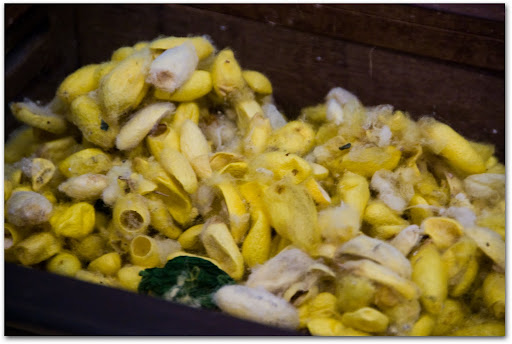
Cocoons
The silk moth lays about 500 eggs in a period of four to six days and then dies. The eggs grow into small worms which became adults in about 20 days. According to Wikipedia, in order to produce 2 pounds of silk, 3000 silkworms need to eat 230 pounds of mulberry leaves. The silk worms spin cocoons to turn into moths. About 75% of the cocoons are used in the silk weaving process and the remaining 25% hatch from the cocoons into moths to produce more eggs.
Cocoons ready to be boiled
The workers boil the cocoons with the live moths inside. Frankly, I find this disgusting. I know that they are insects, it is questionable whether they can feel pain, and most people don't care if they live or die, but it seems wrong to me to boil an insect alive in the name of fashion. But, maybe I am just being overly sensitive. (Apparently, there is a type of silk promoted by Mahatma Gandhi called Ahimsa Silk made from cocoons in which the pupae have been extracted or have naturally flown away.)
 |
 |
 |
 |
Rough silk threads extracted from boiled cocoons
A woman sits with a hand crank all day long to extract the rough silk threads from the boiled cocoons which are then dyed using natural and artificial dyes. The women spin the silk into even thinner fibers until they glisten and glimmer like webbing from a spider.
 |
 |
 |
 |
Spinning raw silk into thin fibers
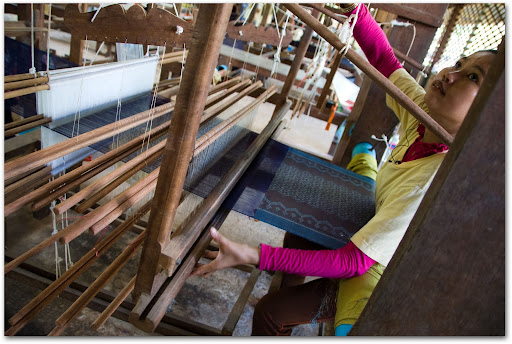
The women then convert the silk threads into amazing designs which is then woven into scarves, ties, and other fabrics with a loom. Amazingly, the women don't listen to music or watch television while performing these wholly monotonous jobs.

Spools of silk thread
We also saw no men working in the silk factory; perhaps silk weaving is traditionally considered "woman's work." (In the same regard, we never saw any female tuk tuk drivers.) These women work long hours and come from nearby villages to produce the beautiful products we found at the end of the tour.

Weaving silk design with a loom
Though we purchased nothing at Artisans d'Angkor, we have gained a newfound appreciation for this labor-intensive and beautiful material.

 Thai
fabrics have a great number of designs, usually distinguished by
region. Northern women have been considered very skillful weavers,
especially of cotton fabrics. They started by weaving for domestic use
and then produced for export as well. It is said that during the
twentieth and twenty-first century BE the northern part of Thailand
which was known as the Laan Na Kingdom produced many good fabrics for
sale in neighbouring states, some of which were Pha Si Chan Khao, Pha Si
Chan Daeng, Pha Si Dok Champa etc..
During the Sukhothai Period, about 700 years ago, besides the ordinary
coloured ones, a five-colour fabric was produced, commonly known as Pha
Benjarong. Different groups of people then produced their own fabrics;
court people for example would make fabrics for themselves and ordered
some fabrics from abroad. As history has it, silk began to be imported
from China during that time. Besides clothing, people began to use
fabrics for other purposes such as home decoration (long flags) and
other household items (pillows, mattresses, curtains).
Fabrics during the Ayudhya Kingdom which was about 400 years ago
assumed another important role besides materials for clothing and
decoration-they were used as money. They were sometimes given by the
king instead of money for rewards and often for the annual remuneration,
hence the term Pha Wad Raipee (pha = fabric or cloth, wad = pension
raipee = annual).
Thai
fabrics have a great number of designs, usually distinguished by
region. Northern women have been considered very skillful weavers,
especially of cotton fabrics. They started by weaving for domestic use
and then produced for export as well. It is said that during the
twentieth and twenty-first century BE the northern part of Thailand
which was known as the Laan Na Kingdom produced many good fabrics for
sale in neighbouring states, some of which were Pha Si Chan Khao, Pha Si
Chan Daeng, Pha Si Dok Champa etc..
During the Sukhothai Period, about 700 years ago, besides the ordinary
coloured ones, a five-colour fabric was produced, commonly known as Pha
Benjarong. Different groups of people then produced their own fabrics;
court people for example would make fabrics for themselves and ordered
some fabrics from abroad. As history has it, silk began to be imported
from China during that time. Besides clothing, people began to use
fabrics for other purposes such as home decoration (long flags) and
other household items (pillows, mattresses, curtains).
Fabrics during the Ayudhya Kingdom which was about 400 years ago
assumed another important role besides materials for clothing and
decoration-they were used as money. They were sometimes given by the
king instead of money for rewards and often for the annual remuneration,
hence the term Pha Wad Raipee (pha = fabric or cloth, wad = pension
raipee = annual). 
